STATE DAY MESSAGE 2026
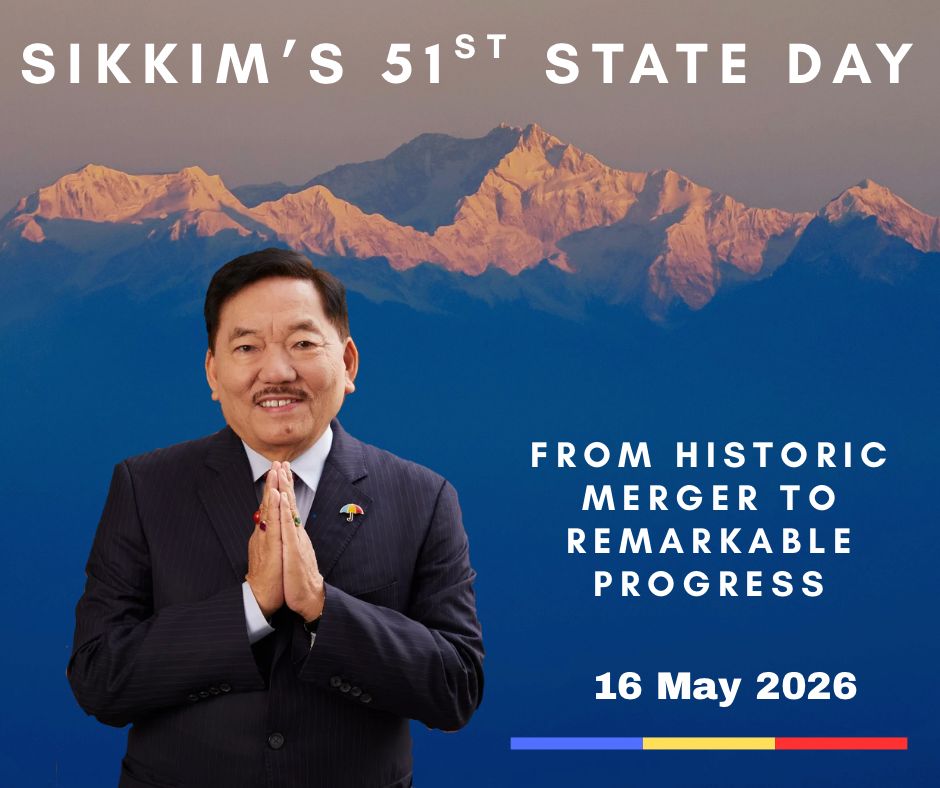
Gangtok:16th May: Former CM Pawan Chamling has conveyed a message to public here He says , ‘On the occasion of the 51st Statehood Day of Sikkim, I extend my heartfelt gratitude and warm greetings to the people of Sikkim. This is a historic and momentous occasion, for it was on this day in 1975 that Sikkim became the 22nd state of India. Since then, Sikkim has traversed an extraordinary journey of peace, progress and national integration.’
On this day, Article 371F was inserted into the Constitution of India as a non obstante clause, safeguarding the old laws, special status, rights, identity, and unique historical character of Sikkim within the Indian Union. This constitutional protection remains one of the strongest foundations of Sikkim’s political and social stability, and it is our collective responsibility to protect and preserve it.
Of the 51 years of Sikkim’s statehood, I feel deeply honoured to have had the opportunity to lead the state for 25 consecutive years under the Sikkim Democratic Front government. During our tenure, we worked with dedication and sincerity to serve the people of Sikkim, to protect Sikkim’s unique identity and status, and to build a peaceful, progressive, and prosperous state.
Among the major milestones achieved during the SDF government, Sikkim became the world’s first fully Organic State in 2016. This historic achievement brought international recognition to Sikkim, including prestigious honours such as the Future Policy Gold Award conferred by the FAO and the United Nations in 2018, and the One World Award (Grand Prix) by IFOAM in 2017. Today, Sikkim is widely recognised across the world not only for its organic identity, but also as an environment-friendly state.
A defining achievement of our tenure was the rapid reduction of poverty. According to the World Bank, Sikkim became one of the fastest regions after World War II to reduce poverty levels. In 1994, when the SDF government assumed office, the Below Poverty Line population stood at 41.43 percent. By 2019, this was reduced to 3.85 percent. One of our earliest policy decisions was to allocate 70 percent of the state budget towards the development of rural Sikkim. Such pro-poor and rural-centric policies played a vital role in this transformation.
In line with our pro-poor agenda, one of our first priorities after forming the government was to ensure the basic minimum needs of the people. Guided by this commitment, we implemented schemes such as the CMRHM as well as the Land Bank Scheme which provided land to the landless. We ensured access to free drinking water and 100 units of free electricity for every household. We also provided 35kg food grains free to BPL families as well as subsidised food grains to others so that basic necessities such as food and shelter were secured for every citizen.
We earned the distinction of becoming a poverty-free state and the first kutcha house-free state in the country. We also focused on providing sanitation facilities to every household, making Sikkim the first Open Defecation Free state in India. In recognition of this achievement, Sikkim was declared the first Nirmal Rajya in the country in 2008. During the SDF government, Sikkim also achieved near-universal road connectivity. The state was conferred the Bharat Nirman Puraskar for having one of the highest road densities in the country.
Sikkim’s economy also witnessed unprecedented growth and stability under the SDF government. The Gross State Domestic Product (GSDP) rose from ₹440.34 crore in 1994 to ₹26,786 crore in 2019, while state revenue increased from ₹44.72 crore to ₹12,052.24 crore during the same period. We consistently maintained revenue-surplus budgets, ensuring fiscal stability and sustainable growth for the benefit of all sections of society. Our economic policies made Sikkim one of the fastest growing states in the country.
The SDF government also laid the foundation for industrialisation in Sikkim by creating an investor-friendly environment and inviting pharmaceutical industries to establish operations in the state. During our tenure, more than 50 pharmaceutical companies established their base in Sikkim, making the state one of India’s leading pharmaceutical manufacturing hubs after Himachal Pradesh. We also harnessed Sikkim’s immense hydropower potential, positioning the state as a major hydropower hub of the country.
The social indicators of Sikkim improved remarkably during the SDF tenure. Life expectancy increased from 62.7 years in 1990 to 73.15 years in 2016, significantly higher than the national average. We also strengthened healthcare infrastructure across the state and built STNM Hospital into one of the largest healthcare institutions in the country after AIIMS. Most importantly, we ensured that access to healthcare remained free for all Sikkimese people.
In a similar vein, we also ensured free education up to the college level, a first-of-its-kind initiative in the country. We provided laptops to students and distributed free uniforms, books, bags, shoes, and other educational essentials. We established premier institutions of higher education such as Sikkim University, Sikkim State University, Sikkim Manipal Institute of Technology, Buddhist University, SRM among others.
We also introduced scholarship programmes such as the Chief Minister’s Meritorious Scholarship Scheme (CMMSS), enabling government school students to study in some of the country’s leading private schools. Similarly, we instituted scholarship schemes for students securing admission to the top 20 universities of the world.
The SDF government also achieved several historic political and social breakthroughs. Today, Sikkim stands as an example of inclusive politics for the entire nation because of policies that ensured representation and opportunities for every community. For instance, we ensured recognition for Central OBC communities soon after forming the government and, in 1995, accorded official state language status to Newari, Rai, Gurung, Mangar, Sherpa, Sunwar, Mukhia, Thami, Bhujel, and Tamang languages, thereby strengthening the cultural identity and inclusiveness of Sikkim.
Scheduled Tribe status for the Limboo and Tamang communities was achieved on 7 January 2003, while Primitive Tribe status for the Lepcha community was granted on 18 November 2006. In 2003, the SDF government also took the bold and historic step of ensuring State OBC recognition for Brahmin, Chettri, and Newar communities in Sikkim. In this way, Sikkimese society itself became an example of inclusive politics in action.
We also achieved many other political milestones. In 2006, the historic Nathula Trade Route was reopened after remaining closed for 44 years, reviving Sikkim’s age-old trade and strategic significance. Another landmark achievement was securing exemption from State Income Tax and Central Income Tax in 2008. Sikkim also became a member of the North Eastern Council in 2002.
During the SDF government, social justice remained a cornerstone of our policies. Our initiatives in social justice became an example for the nation. For instance, we established the Atrocity Court in 1995 and worked decisively to eliminate the practice of untouchability from Sikkimese society.
Before the SDF government, there existed social practices of segregation among communities during communal events such as weddings and social gatherings. We worked towards creating a new culture of acceptance, equality, and communal harmony among all sections of Sikkimese society. We also developed a reservation framework that ensured no individual or community was left excluded from its benefits.
We also undertook major reforms in Panchayati Raj by strengthening decentralisation and devolution of power. Our government invested in infrastructure, institutional capacity, and human resource development to build a strong and vibrant grassroots democratic system in Sikkim.
Women’s empowerment remained a central priority of the SDF government. We introduced 50 percent reservation for women in Panchayati Raj institutions and 33 percent reservation for women in higher education and government jobs. During our tenure, Sikkim also witnessed several historic milestones in women’s leadership, including the appointment of the first woman minister, the first woman Speaker, and the first woman Chief Secretary of the state. Policies and laws such as the Prerna Yojana and the Sikkim Succession Act, 2008 were implemented to further strengthen women’s rights in Sikkim. The Sikkim State Commission for Women was established in 2001.
Tourism flourished under the SDF government with the development of landmark tourism infrastructure such as Siddhesvara Dham (Char Dham) at Namchi, the Chenrezig Statue and Skywalk at Pelling, the Bhaleydhunga Skywalk and Ropeway, and several other projects. We also connected Sikkim to the Buddhist pilgrimage circuit and pioneered the concepts of ecotourism and homestay tourism in the state.
These efforts brought global recognition to Sikkim as a premier tourism destination. In 2014, Sikkim was recognised by Lonely Planet as one of the best regions to visit, and in 2017, The New York Times included Sikkim among its “52 Places to Visit in the World.” Most importantly, throughout these years, we ensured peace, harmony, and political stability in a geopolitically sensitive border state like Sikkim, creating a strong base for progress as well as for the flourishing of the tourism industry.
Another major focus of our government was environmental protection. Sikkim became the first state in India to implement a ban on plastic carry bags. Khangchendzonga National Park (KNP) also became India’s first Mixed World Heritage Site in 2016. We introduced initiatives such as “Ten Minutes to Earth,” banned the burning of firecrackers, prohibited the burning of agricultural waste, and restricted grazing in forest lands. These measures, along with several other environmental policies, helped increase Sikkim’s forest cover from 43.85 percent in 1993 to 47.34 percent in 2013.
I am deeply honoured that during the SDF tenure we were able to serve the state and help build a Sikkim that is today celebrated globally across many sectors. However, one of our foremost priorities throughout our tenure was the protection of Article 371F and the old laws of Sikkim. Whatever work we undertook and whichever policies we framed, we did so while safeguarding the unique constitutional status, identity, and rights of Sikkim and the Sikkimese people. We strengthened the democratic institutions in the state and maintained rule of law. We maintained law and order and protected the sanctity of Article 371F.
All these achievements have been possible most importantly because of the hardworking and resilient people of Sikkim — our farmers, youth, women, public servants, entrepreneurs, intellectuals, and every citizen who contributed towards building a better state.
As we celebrate 51 years of Statehood, this is also a moment to reflect upon our collective responsibilities towards Sikkim and its future. The journey of Sikkim has been built upon peace, unity, harmony, and the hard work of generations of Sikkimese people. It has been built upon embracing progress and development while simultaneously protecting the unique constitutional safeguards enshrined within the Constitution of India. On this historic occasion, let us renew our collective commitment to preserving and strengthening these foundations for future generations.
On the occasion of the 51st Statehood Day, I once again extend my sincere gratitude to the people of Sikkim for their trust, support, and contribution towards building a stronger and more prosperous state. May Sikkim continue to progress with peace, dignity, and unity for generations to come.
About the Author